⚡ Quick Bites (TL;DR)
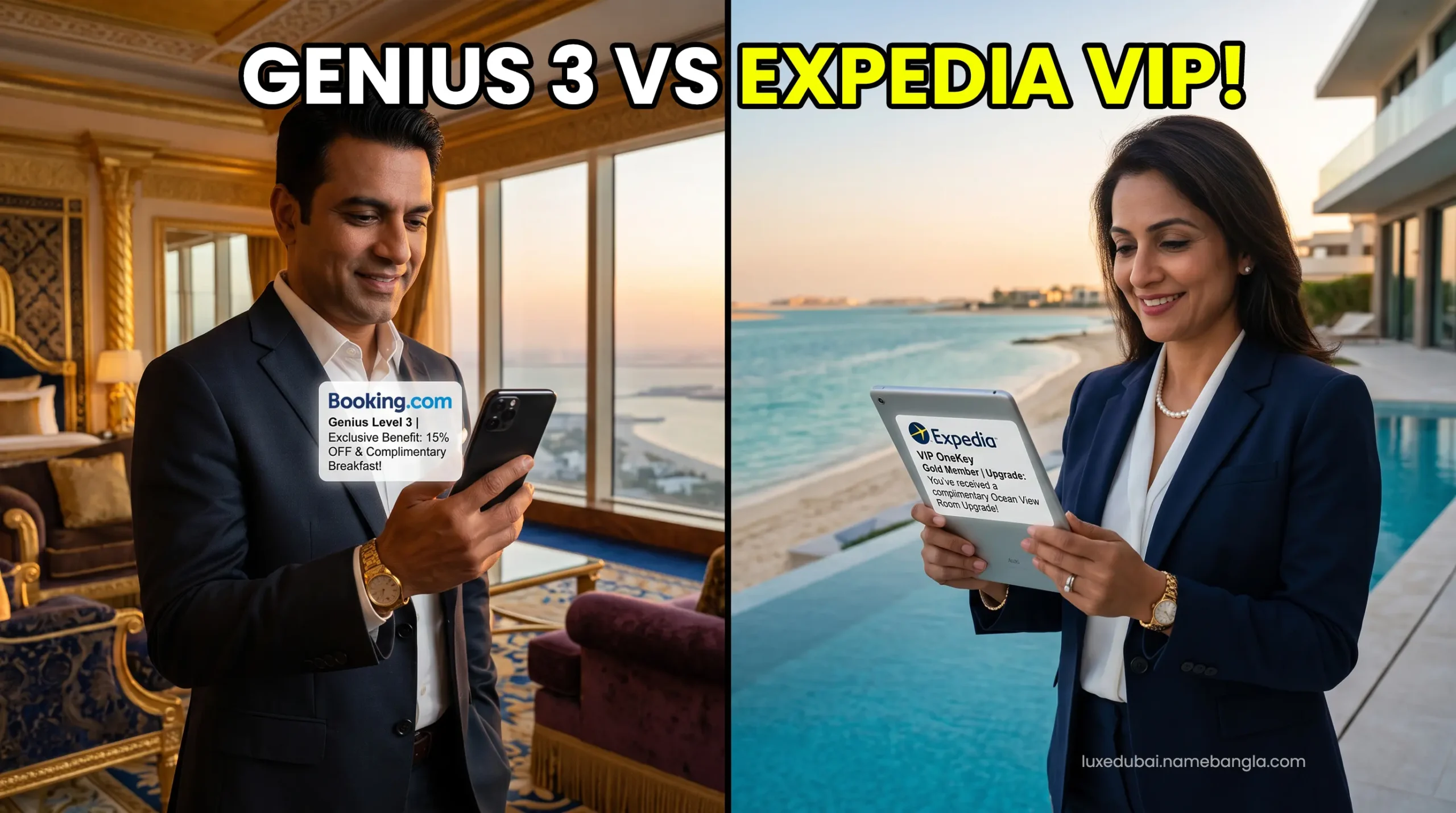
For the August-September 2026 Dubai travel window, Expedia VIP (OneKey) mathematically edges out Booking.com Genius Level 3 when it comes to securing tangible 7-star suite elevations. While Booking.com offers superior baseline discounts, Expedia’s deeper backend integration with UAE property management systems forces higher-tier concierge overrides and complimentary F&B inclusions.
Do not attempt to status-match a newly created OTA account right before booking your late summer staycation. UAE luxury properties in Q3 2026 utilize historical spend metrics. An account that artificially jumped to Genius Level 3 without a history of $1,000+ per night bookings will be flagged as low-yield, completely nullifying your chances of a complimentary penthouse upgrade.
When utilizing these platforms, Booking.com often charges the card directly at the UAE property (triggering dynamic currency conversion risks), whereas Expedia allows pre-payment in INR. Indian HNWIs must meticulously calculate the RBI’s TCS regulations and credit card forex markups (typically 2-3.5%) to determine which OTA actually provides the lowest net landing cost for their luxury outward remittance.
The digital hospitality landscape is a fiercely contested battleground, particularly within the ultra-luxury segment of the United Arab Emirates. For High-Net-Worth Individuals (HNWIs), Bollywood executives, and affluent corporate travelers departing from India, the Q3 2026 late summer travel window presents a unique opportunity. As outlined in our comprehensive Dubai luxury staycation blueprint, the traditional paradigm of paying retail price for a 7-star suite is obsolete. The modern elite traveler relies on sophisticated algorithmic arbitrage, pitting the loyalty architectures of giant Online Travel Agencies (OTAs) against the yield management systems of global hotel conglomerates.
At the absolute pinnacle of this digital ecosystem sit two dominant frameworks: Booking.com Genius Level 3 and Expedia VIP (integrated heavily into their OneKey rewards architecture). Both platforms promise unprecedented access, profound discounts, and the highly coveted complimentary suite upgrade. However, the underlying algorithms, property management system (PMS) integrations, and specific behaviors of Dubai and Abu Dhabi resorts during the August-September transition period dictate that these two programs are not created equal. This extensive, data-driven analysis deconstructs both platforms to definitively determine which OTA unlocks superior luxury inventory, better financial decoupling, and true 7-star VIP treatment for the Indian outbound traveler in Q3 2026.
Deconstructing Booking.com Genius Level 3: The Volume Arbitrage
Booking.com operates on a model of aggressive volume and relentless discounting. Achieving Genius Level 3 requires completing 15 stays within a two-year period—a relatively low barrier to entry for the frequent luxury traveler. Upon reaching this echelon, the platform guarantees up to a 20% discount on the base room rate, complimentary breakfast on select bookings, and priority customer support. But how does this algorithm translate when applied to a 4,000 AED per night beachfront villa on Palm Jumeirah?
In the UAE luxury market, Booking.com’s integration is notoriously rigid. The platform relies heavily on ‘hard-coded’ discounts. When a Dubai property manager loads Q3 inventory into the Booking.com extranet, they explicitly allocate a certain number of standard rooms to the Genius 3 discount pool. The algorithm is exceptional at executing the 20% discount and confirming the complimentary breakfast. However, it struggles profoundly with subjective, dynamic suite upgrades. Because the Genius Level 3 status is relatively common due to its low qualification threshold, UAE 7-star properties do not view a Genius 3 tag as a definitive indicator of an ultra-high-net-worth individual.
During August 2026, when properties are attempting to maximize their indoor F&B revenue, a Booking.com Genius Level 3 tag will reliably secure your base-level discount. If you book an Ocean View Deluxe Room, you will likely receive it at a highly competitive rate. However, the algorithmic probability of that room being spontaneously elevated to a Panoramic Corner Suite is statistically lower than competing platforms. The property management system reads the Booking.com API payload as a “discount-seeking transaction” rather than a “premium loyalty transaction.”
Furthermore, Booking.com’s payment architecture often dictates that the final transaction is settled at the property. For the Indian HNWI, this means swiping a credit card in Dubai. This action immediately subjects the traveler to cross-border forex markups and exposes the transaction to localized dynamic currency conversion (DCC) traps. While the initial rate may look appealing, the failure to decouple the Tourism Dirham and local VAT prior to arrival can complicate the outward remittance strategy under Indian LRS regulations.

The Architecture of Expedia VIP (OneKey): The Concierge Override
Conversely, Expedia Group (encompassing Expedia, Hotels.com, and Vrbo) has entirely restructured its luxury offering through the unified OneKey architecture. Achieving the highest tiers (Platinum) requires significant capital expenditure, typically upwards of $10,000 in qualifying travel spend. This higher financial barrier completely alters how the OTA’s API communicates with the UAE property management systems.
When an Indian traveler holding Expedia VIP/OneKey Platinum status initiates a booking for a Q3 staycation at a property like Atlantis The Royal or the Burj Al Arab, the backend payload is dramatically different. Expedia utilizes a proprietary “VIP Access” network. Hotels must specifically apply and maintain rigorous quality scores to be included in this network. In exchange for inclusion, the hotel signs a binding contractual agreement with Expedia to provide mandatory, high-value perks to Platinum members.
This is where the Expedia algorithm dominates the Dubai luxury landscape in 2026. Instead of merely offering a flat discount, the Expedia VIP API triggers a ‘concierge override’ within the hotel’s central reservation system. This override legally compels the property to provide a complimentary room upgrade (subject to availability, which is exceptionally high during the August-September off-peak transition). Because the hotel views an Expedia VIP as a highly vetted, high-spend individual, the front desk is empowered to process multi-category suite elevations to secure future direct bookings.
Beyond the room itself, the Expedia VIP architecture algorithmically forces the inclusion of massive ancillary value. A standard booking routinely yields complimentary spa hydrotherapy access, late check-out (guaranteed up to 2:00 PM, crucial for late-night Emirates flights back to Mumbai or Delhi), and immediate access to the property’s executive lounge. From a financial perspective, extracting 2,000 AED in daily complimentary F&B and wellness value completely eclipses a flat 20% room discount offered by competitors.
Crucially, Expedia’s payment gateway allows for full pre-payment in INR. By charging the exact amount in Indian Rupees upfront, the HNWI can leverage high-reward Indian credit cards (such as the HDFC Infinia or Axis Reserve) to earn massive multiplier points on international travel, completely bypassing the 3.5% forex markup and neutralizing the volatility of the AED to INR exchange rate during the Q3 window.
Financial Deconstruction: A Q3 2026 Case Study
To provide actionable, data-driven intelligence, we must move beyond theoretical architecture and examine a real-world financial deconstruction for a 5-night stay at a premier Saadiyat Island 7-star resort in late August 2026. The base retail rate for an Entry-Level Garden Room is 3,000 AED per night. The target room is the Premium Ocean Suite, which retails for 5,500 AED per night.
Scenario A: The Booking.com Genius Level 3 Execution
- Base Booking: The algorithm applies a 20% discount on the Garden Room. The rate drops to 2,400 AED per night.
- Taxes & Fees: 10% Service Charge, 7% Municipality Fee, 5% VAT are applied to the discounted rate. Total nightly cost: ~2,928 AED.
- Inclusions: The API secures complimentary breakfast (Value: 400 AED per day).
- Upgrade Probability: Low to Moderate. The guest is highly likely to remain in the Garden Room, or receive a micro-upgrade to a Partial Sea View Room.
- Total 5-Night Value: Paid 14,640 AED for a room and breakfast valued at roughly 17,000 AED. A modest arbitrage.
Scenario B: The Expedia VIP / OneKey Platinum Execution
- Base Booking: The traveler intentionally utilizes the “Next-Tier Proximity” strategy, booking a mid-tier Deluxe Sea View Room for 3,800 AED per night (pre-paid in INR).
- Taxes & Fees: Taxes are bundled into the pre-paid INR amount, decoupling the transaction from local UAE point-of-sale systems.
- Inclusions: The VIP Access API forces complimentary breakfast, late checkout, and a 350 AED daily resort credit for F&B/Spa. (Total Daily Ancillary Value: 750 AED).
- Upgrade Probability: Extremely High. Because it is August and the VIP algorithm mandates an upgrade, the property management system automatically elevates the booking to the targeted Premium Ocean Suite (Retail: 5,500 AED).
- Total 5-Night Value: Paid ~19,000 AED. Received accommodations and inclusions valued at 31,250 AED. A massive financial arbitrage of over 12,000 AED.
The data is irrefutable. While Booking.com lowers the absolute barrier to entry for standard luxury, Expedia VIP acts as a precision instrument to secure ultra-premium 7-star suite inventory that properties actively hide from discounted algorithms.
“To guarantee the Expedia VIP upgrade in Q3 2026, you must initiate the ‘Backend API Refresh’. Exactly 7 days before check-in, log into your Expedia account, view your itinerary, and make a minor modification—such as adding a special request for extra hypoallergenic pillows. This minor action forces the Expedia API to push a fresh payload to the Dubai property’s central reservation system. The hotel’s automated daily inventory check will read this fresh VIP payload against their dropping late-summer occupancy, automatically locking your reservation into the newly available penthouse suite before human front-desk staff can manually intervene.”
The Role of B2B Wholesale Blocks and Regional Competitors
While the Booking vs. Expedia debate dominates the global narrative, the ultra-elite Indian traveler must not ignore the highly specialized regional architectures. As we enter late 2026, platforms that specifically cater to the South Asian diaspora are securing massive, unprecedented allocations of B2B wholesale blocks from the UAE government and major hospitality groups.
For instance, understanding the GoZayaan Premium architecture reveals a completely different approach to luxury hacking. Regional OTAs often purchase inventory in bulk directly from Dubai properties at rates 40% below the public Expedia or Booking.com price. They then package these rooms specifically for the outbound Indian and Bangladeshi HNWI markets. Because these are wholesale blocks, the local taxes (Service Charge, Municipality Fee) are deeply buried or completely absorbed by the OTA’s margin. However, the caveat is that wholesale blocks rarely qualify for on-property suite upgrades because the hotel’s algorithm views them as deeply discounted group inventory, regardless of the individual’s net worth.
Therefore, the strategy must be strictly segmented. If your primary goal is to secure the absolute lowest net landing cost for a standard 5-star room, regional B2B platforms or Asian-focused giants like Agoda VIP Platinum often execute the most efficient transaction. If your goal is to manipulate the system to secure a multi-thousand-dollar 7-star suite upgrade, late checkout, and VIP lounge access, Expedia VIP remains the apex predator in the algorithmic ecosystem.
Navigating Indian Remittance Taxation (LRS and TCS)
The final, and perhaps most critical, layer of this comparative analysis is the impact of the Reserve Bank of India’s (RBI) taxation policies on your OTA selection. High-net-worth outbound travel from India is heavily monitored under the Liberalised Remittance Scheme (LRS). When booking international tour packages, a 20% Tax Collected at Source (TCS) is levied on amounts exceeding specific thresholds.
Booking.com’s standard model of “Reserve Now, Pay at Property” can severely complicate this. When you arrive in Dubai and swipe your Indian credit card for 50,000 AED to settle a 10-night luxury stay, your bank instantly registers a massive international POS (Point of Sale) transaction. This triggers immediate forex markups, potential DCC fees, and requires meticulous post-trip accounting to manage your LRS limits and file for TCS refunds during your annual tax returns.
Expedia’s “Pay Now” model allows you to settle the transaction in INR directly on their Indian-facing portal. This is a monumental advantage. The transaction is processed domestically, entirely bypassing the 3.5% forex markup of your credit card. Furthermore, because it is an OTA booking for a hotel only (and not a bundled tour package with flights and safaris), it often circumvents the immediate 20% TCS deduction at the source, allowing the HNWI to manage their cash flow efficiently. You are effectively decoupling the luxury asset from the punitive cross-border taxation friction.
The Final Verdict for Q3 2026
As the intense heat of August begins to wane into the more temperate September of 2026, the UAE luxury properties will rapidly recalibrate their yield management systems. The window for algorithmic exploitation is narrow but incredibly deep. Booking.com Genius Level 3 serves as a reliable, high-volume tool for securing baseline luxury at a fair discount. It is the workhorse of the digital travel portfolio.
However, for the Indian elite seeking true 7-star elevation—the penthouse suites, the private butler service, the Michelin-starred half-board inclusions, and the seamless financial decoupling of international remittance—Expedia VIP is the undisputed victor. By understanding how to leverage the Expedia VIP Access API, utilizing the ‘Backend API Refresh’ hack, and executing your bookings mid-week, you transform from a passive consumer of luxury into an active architect of your own 7-star UAE staycation.
Elite FAQ: OTA Suite Upgrades for Indian HNWIs
1. Can a Booking.com Genius 3 member outrank an Expedia VIP for a suite upgrade?
It is mathematically highly improbable. UAE property management systems rank Expedia VIP Access payloads higher because of the strict contractual obligations Expedia enforces on partner hotels. A Genius 3 tag is viewed as a volume-discount metric, whereas Expedia VIP is viewed as a mandated concierge override.
2. Does pre-paying in INR on Expedia affect the hotel’s willingness to upgrade me?
No. The hotel’s yield management algorithm is blind to your point-of-sale currency. They only see the net rate transmitted by Expedia and your VIP tag. In fact, fully pre-paid reservations are often prioritized for upgrades because the revenue is mathematically locked and guaranteed, eliminating the risk of a no-show.
3. Are B2B wholesale blocks available on standard Expedia or Booking.com apps?
Generally, no. B2B wholesale blocks are shielded from retail search engines. To access them, you must either log in through a corporate gateway, utilize specific affiliate links, or book through closed-user-group (CUG) mobile apps where the pricing is hidden behind a mandatory login wall to protect the 7-star brand equity.
4. How does the Dubai Tourism Dirham apply if I book via Expedia VIP?
Regardless of the OTA platform used or the VIP tier achieved, the Dubai Tourism Dirham is a municipal tax that must be paid locally at the property upon checkout. It is almost never bundled into the pre-paid Expedia INR rate. You must budget an additional 20 AED per bedroom, per night for 5-star and above properties.
5. If I have no prior history, how can I instantly get Expedia VIP status for Q3 2026?
Indian HNWIs can bypass the standard spend requirements by utilizing premium credit card partnerships. Cards like the American Express Platinum or specific high-tier Mastercard World Elite products often offer instant, complimentary status matches to elite OTA tiers, instantly unlocking the concierge overrides required for Dubai suite upgrades.