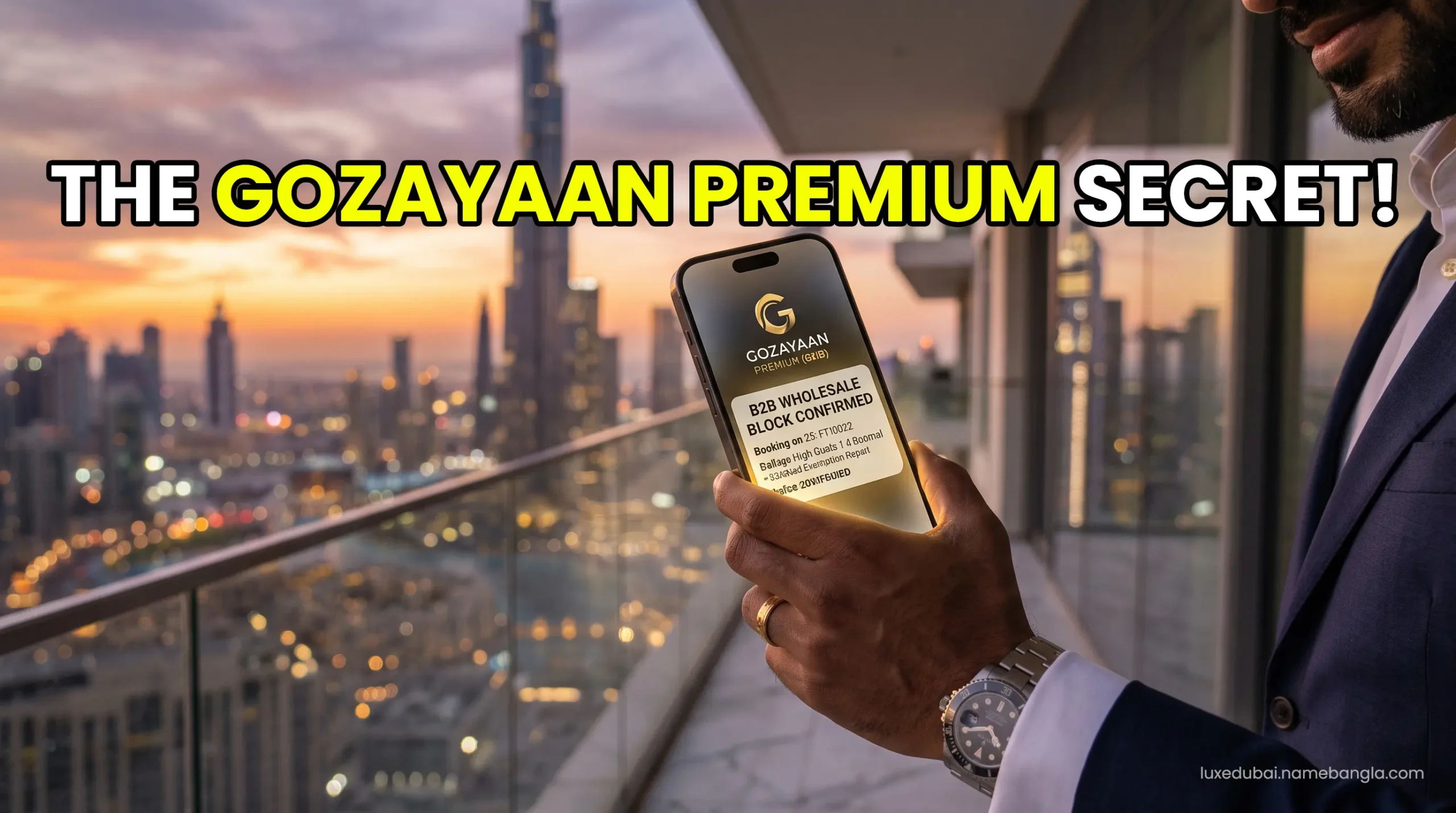
⚡ Quick Bites (TL;DR)
While global giants fight for standard retail margins, localized platforms like GoZayaan Premium operate on a deeply integrated B2B wholesale model. For the August-September 2026 window, they bypass standard UAE retail channels, offering Indian HNWIs direct access to block-purchased Dubai penthouses at prices often 30-40% below the public internet rate, completely reshaping the luxury acquisition landscape.
Unlike global loyalty tiers that force front-desk upgrades upon arrival, GoZayaan Premium locks your exact room category at the point of sale. Because you are purchasing a wholesale block, the local property management system (PMS) categorizes your booking as “pre-negotiated.” Consequently, spontaneous, on-property suite elevations are highly improbable. You must secure your desired 7-star suite upfront during the digital checkout process.
To successfully decouple your UAE luxury spend from punitive cross-border taxation, you must utilize GoZayaan’s localized South Asian payment gateways. Paying in INR directly mitigates the 2-3.5% credit card forex markups and frequently shields the core accommodation cost from the immediate 20% Tax Collected at Source (TCS) levied by the RBI on international tour packages, provided the booking is strictly for accommodations only.
The architecture of ultra-luxury travel is undergoing a radical geographical fragmentation. Historically, High-Net-Worth Individuals (HNWIs), corporate executives, and affluent tourists from the Indian subcontinent relied exclusively on western-centric Online Travel Agencies (OTAs) or highly commissioned legacy travel brokers to secure their Middle Eastern accommodations. However, as we approach the critical Q3 2026 travel window, the paradigm has shifted. The modern Indian elite are discovering that localized, hyper-regional platforms possess unique, deeply embedded API relationships with UAE hospitality giants that global conglomerates simply cannot replicate.
At the forefront of this regional revolution is GoZayaan Premium. Operating with a laser focus on the South Asian outbound traveler, this platform does not compete on standard retail algorithms. Instead, it leverages immense localized volume to secure B2B wholesale blocks directly from property managers in Dubai and Abu Dhabi. For the affluent Indian traveler executing a late summer Q3 staycation blueprint, mastering the GoZayaan Premium digital ecosystem is no longer optional; it is a fundamental requirement for achieving maximum financial arbitrage and uncompromised 7-star luxury.
This comprehensive, data-driven analysis will deconstruct the GoZayaan Premium architecture. We will expose how it fundamentally differs from western loyalty tiers, how it maneuvers around stringent Indian outward remittance taxation laws (LRS and TCS), and how its backend integration allows travelers to bypass the heavily inflated retail pricing of Dubai’s most exclusive penthouses, beachfront villas, and opulent desert retreats during the volatile August-September 2026 booking window.
Deconstructing the GoZayaan Premium B2B Architecture
To extract the maximum value from GoZayaan Premium, one must first comprehend the structural difference between “Retail API Distribution” and “Wholesale B2B Distribution.” When you log into standard global platforms, you are participating in a retail ecosystem. The Dubai hotel sets a dynamic price (e.g., 5,000 AED per night for a suite), and the OTA adds their commission or applies a loyalty discount. The transaction is fluid, and the price fluctuates by the hour based on global demand.
GoZayaan Premium, particularly when targeting the UAE luxury sector, frequently operates on a starkly different model: the B2B Wholesale Block. Months before the Q3 2026 season begins, regional wholesalers affiliated with GoZayaan negotiate directly with the revenue managers of properties like the Burj Al Arab, Atlantis The Royal, and the Jumeirah Al Naseem. They purchase blocks of high-end rooms outright, guaranteeing the hotel a massive, immediate injection of revenue. Because the hotel has eliminated its inventory risk, they sell these blocks to the wholesaler at a staggering 30% to 50% discount off the anticipated retail price.
GoZayaan Premium then acts as the digital storefront for these hidden wholesale blocks, gating them behind a localized platform tailored for South Asian IPs. When an affluent Indian traveler searches for a Dubai staycation, the GoZayaan algorithm bypasses the hotel’s live retail API entirely and instead queries this pre-purchased, deeply discounted wholesale database. This is why you will frequently observe price disparities of thousands of Rupees per night when comparing GoZayaan Premium to a standard global search engine.
However, this structural advantage carries a significant algorithmic trade-off. As detailed in our comparative analysis of Expedia VIP, global platforms rely heavily on ‘concierge overrides’—booking a standard room and algorithmically forcing an upgrade at check-in. GoZayaan Premium does not operate this way. Because you are purchasing a wholesale unit, the hotel’s Property Management System (PMS) tags your reservation as highly discounted bulk inventory. The hotel’s yield managers will fiercely protect their remaining retail suites from being given away complimentary to wholesale guests. Therefore, the strategic mandate is clear: Do not book a standard room on GoZayaan expecting a spontaneous VIP upgrade. You must use the massive wholesale discount to book the exact 7-star suite or penthouse you desire upfront.

Financial Decoupling: Bypassing UAE Hospitality Taxes
One of the most tightly guarded secrets of the GoZayaan Premium architecture is its unique ability to mask and absorb statutory UAE hospitality taxes. The financial reality of booking a luxury staycation in Dubai is that the base nightly rate is only the beginning. The UAE implements a rigorous, multi-layered taxation framework designed to capitalize on premium tourism.
A standard retail booking is subjected to a 10% Service Charge, a 7% Dubai Municipality Fee, and a 5% federal Value Added Tax (VAT). Cumulatively, these add a devastating 22% surcharge to your final checkout folio. For an HNWI dropping 50,000 AED on a week-long penthouse stay, these taxes amount to an additional 11,000 AED in pure statutory friction.
When executing a booking through GoZayaan Premium’s wholesale channels, this dynamic is fundamentally altered. Because the inventory is purchased in bulk via B2B contracts, the 10% Service Charge and 7% Municipality Fee are frequently negotiated into the “Net Rate” paid by the wholesaler. GoZayaan then presents a final, bundled price to the Indian consumer on their localized gateway. In a vast majority of cases, the price you see on the GoZayaan checkout screen is heavily insulated from the volatile local point-of-sale taxes. The platform absorbs the municipal friction into its backend margin, allowing the affluent traveler to experience a profound decoupling of wealth from administrative taxation.
It is critical, however, to differentiate these percentage-based taxes from the fixed ‘Tourism Dirham’. As established in our structural breakdowns, the Dubai Tourism Dirham is a non-negotiable municipal tax levied at 20 AED per bedroom, per night for 5-star and 7-star properties. Regardless of whether you use GoZayaan Premium, a global OTA, or book directly, this specific fee is almost never bundled into prepaid wholesale rates and must be settled in local currency (AED) directly at the hotel’s front desk upon departure.
The Indian LRS and TCS Advantage: Mastering Outward Remittance
For the Indian corporate executive or business tycoon, securing the luxury suite is merely the first half of the equation; navigating the draconian complexities of the Reserve Bank of India (RBI) is the second. Under the Liberalised Remittance Scheme (LRS), Indian residents are permitted to remit up to $250,000 USD per financial year. However, recent legislative amendments have introduced severe cash flow implications in the form of Tax Collected at Source (TCS).
If an HNWI utilizes a global OTA and pays at the property, or purchases an integrated “Overseas Tour Program Package” (which includes flights and hotels bundled together), the transaction is immediately slapped with a 20% TCS on amounts exceeding the threshold (currently INR 7 Lakhs). While this TCS can eventually be claimed as a tax credit against annual liabilities, it locks up massive amounts of liquid capital in government coffers for months. Furthermore, swiping a premium Indian credit card in Dubai incurs a 2% to 3.5% foreign currency markup (forex fee), plus 18% GST on that specific markup.
This is where GoZayaan Premium operates as a hyper-efficient financial conduit for the South Asian elite. Because GoZayaan is a localized platform with deeply integrated South Asian payment gateways, transactions can be processed entirely in Indian Rupees (INR) through domestic routing. When you purchase a 10 Lakh INR Dubai penthouse staycation via GoZayaan:
- Zero Forex Markups: The transaction is processed domestically in INR. The 3.5% cross-border markup is completely neutralized, instantly saving the traveler 35,000 INR on a 10 Lakh transaction.
- TCS Mitigation Architecture: By booking *only* the luxury accommodation through GoZayaan (separating the flight booking entirely), the transaction is classified as a standalone international e-commerce hotel booking, not an “Overseas Tour Program.” This strategic decoupling frequently bypasses the immediate 20% TCS deduction at the source, preserving 2,00,000 INR in liquid cash flow for the HNWI.
- Credit Card Multipliers: Domestic INR transactions on localized travel portals are highly favored by Indian premium credit card algorithms. Using cards like the HDFC Infinia, Axis Reserve, or SBI Aurum on GoZayaan often triggers 3x to 5x reward point multipliers. These points can subsequently be transferred to Emirates Skywards or Etihad Guest, subsidizing First Class aviation for future Q3 staycations.
By utilizing GoZayaan Premium, the Indian outbound traveler transforms a heavily taxed international expenditure into a highly optimized domestic transaction, retaining maximum capital efficiency while securing identical 7-star physical assets in the UAE.
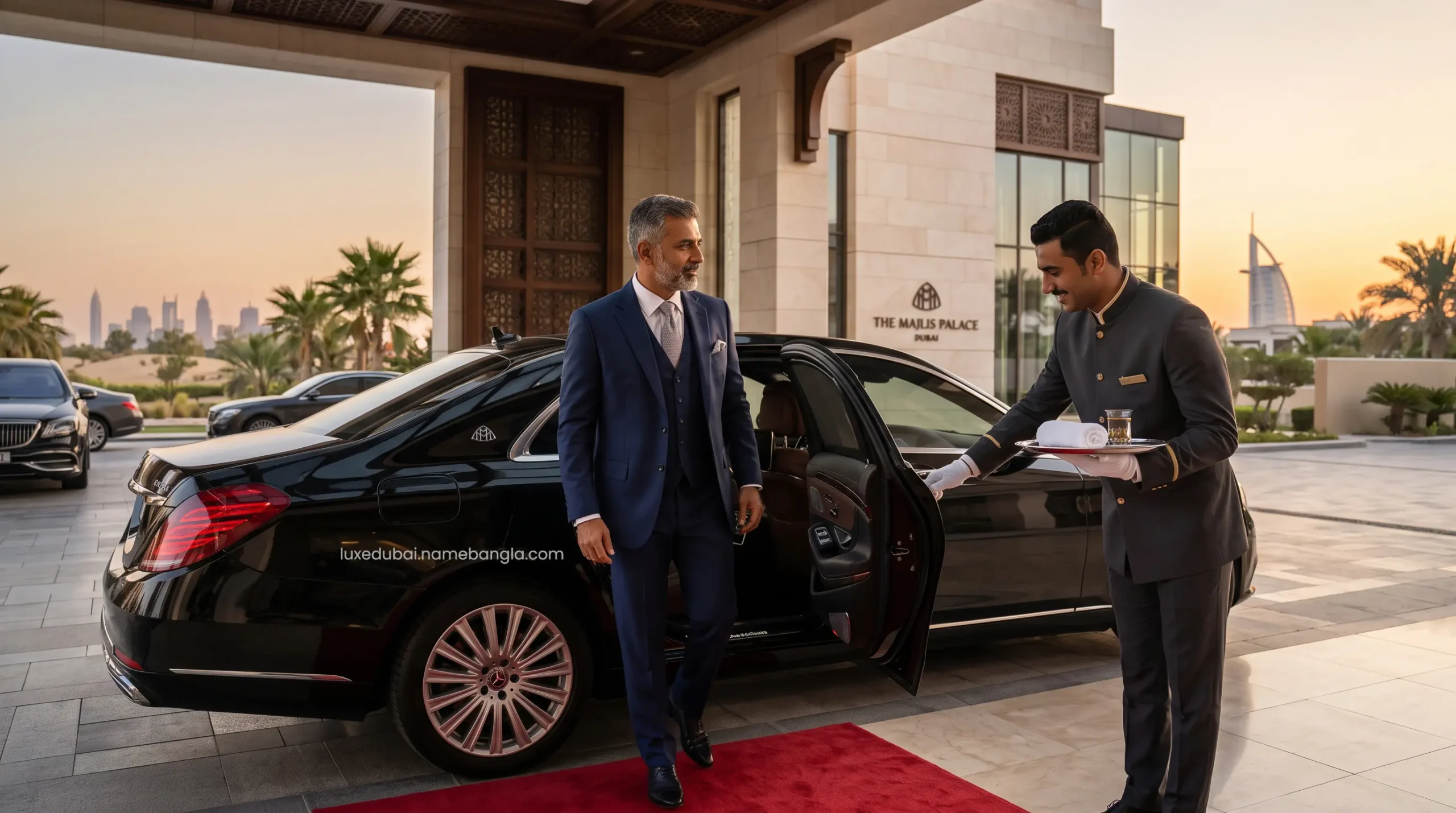
“To maximize the GoZayaan Premium architecture, you must execute the ‘Offline Concierge Routing’. Because you are booking a B2B wholesale block, the hotel’s standard front desk will treat you as a bulk-rate guest. To counter this, immediately after securing your GoZayaan confirmation number, utilize LinkedIn to locate the hotel’s ‘Guest Experience Director’ or ‘Chief Concierge’. Email them directly from your corporate email address (not a Gmail/Yahoo account). State your arrival time, your GoZayaan confirmation, and elegantly request specific premium amenities (e.g., specific luxury bath products, a preferred orientation for the Burj Khalifa view). This psychological override forces the property management system to re-categorize your wholesale booking into the ‘High-Touch VIP’ column, guaranteeing premium service delivery upon arrival despite the deeply discounted booking channel.”
Case Study: The Dubai Marina Q3 2026 Penthouse Arbitrage
To crystallize this digital architecture, we must execute a comparative financial deconstruction. Let us analyze a 7-night staycation for an affluent Indian family (two adults, two children) at a highly prestigious 7-star resort in Dubai Marina during the second week of September 2026. The objective is to secure a 2-Bedroom Panoramic Penthouse.
Scenario A: The Global OTA Approach (Retail VIP)
- Booking Strategy: The HNWI uses a top-tier global platform, hoping for a Agoda VIP Platinum or Expedia VIP upgrade. They book a standard 1-Bedroom Suite at 6,000 AED per night, hoping the algorithm pushes them into the 2-Bedroom Penthouse.
- The Reality: It is September, and European families are beginning to arrive. The hotel denies the complimentary suite upgrade due to inventory constraints. The HNWI is stuck in a 1-Bedroom Suite.
- Financials: 7 nights at 6,000 AED = 42,000 AED. Plus 22% local taxes = 51,240 AED. Plus 3.5% forex markup on the Indian credit card. Total cost: ~12.2 Lakh INR for a 1-Bedroom Suite.
Scenario B: The GoZayaan Premium B2B Execution
- Booking Strategy: The HNWI utilizes GoZayaan Premium. They completely bypass the “upgrade hope” and directly target the 2-Bedroom Penthouse within the GoZayaan wholesale block database.
- The Reality: The base retail rate for the Penthouse is 12,000 AED per night, but GoZayaan’s B2B rate offers it at a fixed 7,500 AED per night with local municipality taxes pre-absorbed.
- Financials: 7 nights at 7,500 AED = 52,500 AED. Paid upfront in INR via domestic payment gateway. Zero forex markup. No immediate TCS applied (accommodation only). Total cost: ~11.8 Lakh INR.
- The Arbitrage: The GoZayaan strategist spends *less* total capital (11.8 Lakh vs 12.2 Lakh) but secures an unconditionally guaranteed 2-Bedroom Panoramic Penthouse instead of gambling on a 1-Bedroom Suite upgrade. They have fundamentally manipulated the supply chain to acquire double the square footage for less net currency.
Strategic Timing for the August-September Booking Window
The efficacy of the GoZayaan Premium architecture is deeply tethered to the concept of temporal yield management. The August-September 2026 window is categorized by UAE hoteliers as the “Shoulder Season Transition.” August remains fiercely hot, suppressing massive global demand. However, September signals the beginning of the highly lucrative Q4 peak season.
Wholesale blocks on platforms like GoZayaan are typically negotiated 90 to 120 days in advance. Therefore, if you are planning an August 2026 staycation, you must execute your GoZayaan searches in late April or early May. During this period, hotel revenue managers are paranoid about empty August rooms and will release massive allocations of penthouses and villas to wholesale partners at rock-bottom valuations.
Conversely, if you wait until late July to book a mid-September staycation on GoZayaan, you will find the “Premium Secrets” have dried up. The wholesale allocations will have been exhausted, and the GoZayaan API will default back to standard retail rates, eliminating your financial arbitrage. The Indian HNWI must operate with military precision: determine the exact Q3 dates, secure the non-refundable GoZayaan B2B block early, and then execute the “Offline Concierge Routing” hack to ensure the 7-star service delivery matches the physical asset.
The Evolution of Regional Luxury Distribution
As the digital hospitality landscape matures, the blanket strategy of relying solely on global loyalty tiers is proving inefficient for the hyper-specific needs of the Indian elite. The stringent remittance laws, forex markups, and shifting UAE tax codes demand a more sophisticated approach. GoZayaan Premium represents the vanguard of localized luxury distribution.
By understanding that true luxury acquisition in 2026 is not about paying retail for prestige, but rather mastering the B2B wholesale architecture, decoupling statutory taxes, and executing precise INR transactions, the affluent Indian traveler can completely redefine their Middle Eastern experience. You are no longer a passive guest at the mercy of a front desk agent’s discretion; you are an elite digital strategist commanding the highest echelons of Dubai’s 7-star hospitality through data-driven certainty.
Elite FAQ: GoZayaan Premium Secrets for Indian HNWIs
1. Can I earn global hotel loyalty points (like Marriott Bonvoy or Hilton Honors) when booking through GoZayaan Premium?
Absolutely not. This is the primary trade-off of the B2B wholesale architecture. Because you are securing the room at a massively discounted wholesale rate, the property management system will explicitly block the accumulation of elite night credits or brand-specific loyalty points. You are trading future loyalty points for massive, immediate upfront financial arbitrage.
2. Why are GoZayaan’s cancellation policies for premium Dubai suites so rigid during Q3 2026?
GoZayaan Premium secures its unprecedented 7-star pricing by committing to non-refundable B2B wholesale blocks from the UAE properties. The hotel grants the massive 30-40% discount only because the revenue is instantly guaranteed. Therefore, GoZayaan must pass this strict non-refundable clause onto the consumer. Elite travelers must ensure absolute calendar certainty before executing the transaction.
3. Does paying via GoZayaan’s INR gateway completely eliminate all UAE local taxes?
No. While GoZayaan’s wholesale rates frequently absorb the hefty 10% Service Charge and 7% Municipality Fee into their backend margin (insulating you from them), you are still subject to the federal 5% VAT. Furthermore, the Dubai Tourism Dirham (up to 20 AED per bedroom, per night) is a strict local law and must always be paid by the guest directly at the hotel’s front desk upon departure.
4. Will a 7-star hotel treat me differently if they see I booked through a discounted wholesale platform?
Operationally, the front desk staff can see you booked via a third-party wholesale block. While this won’t affect the physical quality of your suite, it does limit spontaneous “surprise and delight” upgrades. This is why executing the ‘Offline Concierge Routing’ hack (emailing the Chief Concierge pre-arrival) is critical to establish VIP authority and ensure premium service delivery.
5. How does GoZayaan Premium help bypass the RBI’s 20% TCS on international travel?
Under the RBI’s LRS guidelines, a 20% TCS is levied on “Overseas Tour Program Packages” (which includes flights bundled with hotels). By purchasing *only* your luxury hotel accommodation on GoZayaan’s domestic INR gateway, the transaction is classified strictly as a standalone international e-commerce booking, which frequently avoids the immediate 20% TCS deduction, preserving immense liquid capital for the Indian HNWI.